A Case for Canonization: Rediscovering Ellen Richter's Comedy Moral (1928)
Looking at the canon of German films from the silent era, there is not much to laugh about. Apart from a few early films by Ernst Lubitsch, it contains not a single comedy. This calls for a revision. A worthy candidate for a place in a renewed canon—one that also includes comedies and female stars—is Moral (1928). In it, Ellen Richter plays the leading role of a revue star who defends herself against men’s advances—with the aid of, among other things, a hidden movie camera. For over ninety years, no screenable version of the film existed; fortunately, that changed following its restoration in 2020.1
Why is the film so worth seeing? It is fast-paced and self-reflexive, witty and inventive, not least in cinematic terms, and it anticipates modes of staging later used in the international success Der blaue Engel (The Blue Angel, 1930). It can be regarded as the major work of the long-forgotten star Ellen Richter: a film that mocks narrow-mindedness, provincialism, and male cliquishness while advocating diversity and emancipation. It is inseparably connected with the rise and fall of Weimar entertainment culture—revue theater, operetta, and cabaret—which was shaped to a decisive degree by Jewish artists. Modern and topical upon its release in 1928, the film has, in its own way, remained so ever since.
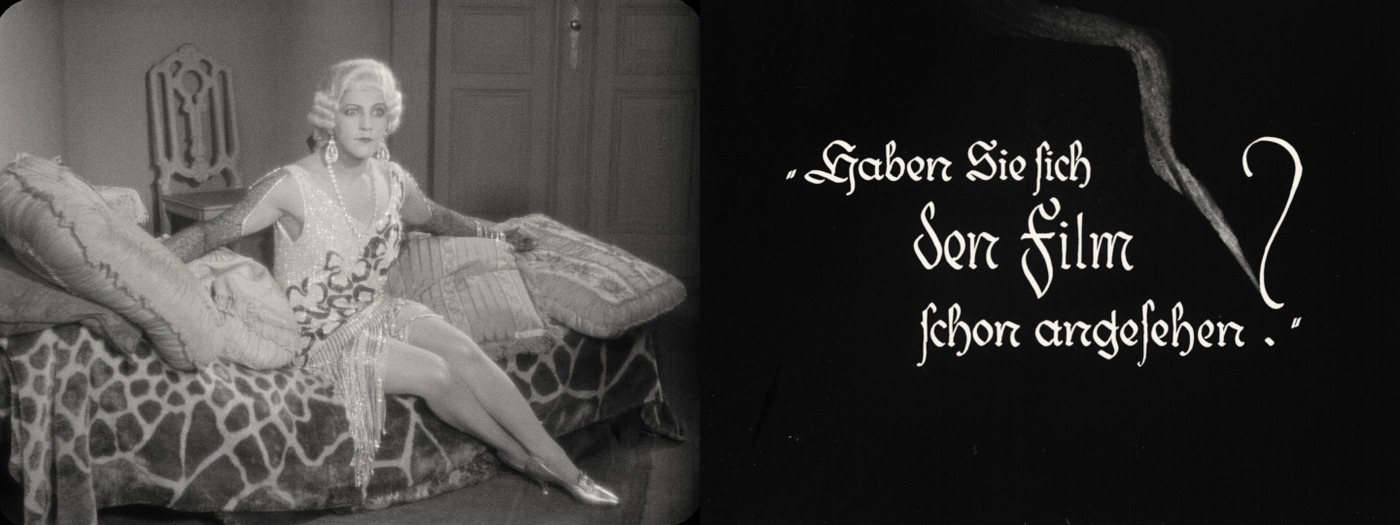
“Have you already watched the film?” Fashion-conscious, very angry, and tech-savvy, a revue star, played by Ellen Richter, shoots her own film to expose her opponents. Frame grabs from the restored version of Moral (DFF).
A scandal! Long rows of dancers fling their bare legs into the air in unison; dozens of scantily-clad showgirls whirl in circles and climb ladders and scaffolds; a solo dancer in a glittering costume that leaves nothing to the imagination performs a Charleston. “Tempo! Tempo!” is the title of the lavish Berlin revue being performed at the theater in the fictitious provincial town of Emilsburg, where it plunges the local audience into a state of fascination, curiosity, and horror. In the climactic final number, “The Prince and the Lady-in-Waiting”, a young man crawls out from beneath the enormous hoop skirt of a masked Rococo lady. What could he possibly have been doing there?
At this moment, a tumult breaks out in the theater, instigated by the local Society for Public Morality. With loud rattles, horns, and boos, the performers are driven from the stage.
This is the first of many high points of the comedy Moral, loosely based on Ludwig Thoma’s 1908 play of the same title. As the story unfolds, Ninon, the publicly humiliated female revue star, exposes her opponents’ double standard with intelligence and charm.
Ninon is played by Ellen Richter (1891–1969), who was also the film’s producer. The director was her husband and most important collaborator, Willi Wolff (1883–1947). Richter endows the protagonist with all the qualities then associated with the New Woman. Ninon is a self-confident artist who makes her own living. Her place is on the stage, not in the kitchen or the nursery. Unmarried and childless, she appears in an ever-changing series of increasingly daring costumes and projects an openly sexual allure. She flirts with her eyes and proudly displays her body and bare upper arms. She also wears her bob haircut so short that she might almost be mistaken for a boy.
Moral shows the collision of urbanity and provincialism, modernity and tradition, freedom and repression. At its core is a humorous struggle over a new gender order, sexuality, and representation—some of the central conflicts in Weimar-era culture. In Moral, Richter and Wolff created one of Weimar cinema’s funniest and most inventive comedies, as well as a work that is self-reflexive in many respects. In view of the overt and violent hostility that the political right directed against representatives of a modern, metropolitan, cosmopolitan, and at times erotic and hedonistic entertainment culture, long before 1933, the film can also be considered remarkably prescient.
Five years after their success with Moral, Richter and Wolff were forced to stop working in the German film industry by the National Socialists, who had just come to power. It was considered sufficient justification that they were Jews and therefore had no place in a new German cultural life organized along völkisch-nationalist lines. After 1933, Ellen Richter never appeared in another film; Willi Wolff never directed again. They were expelled from the film industry and also from cinema’s memory, from film history itself.2
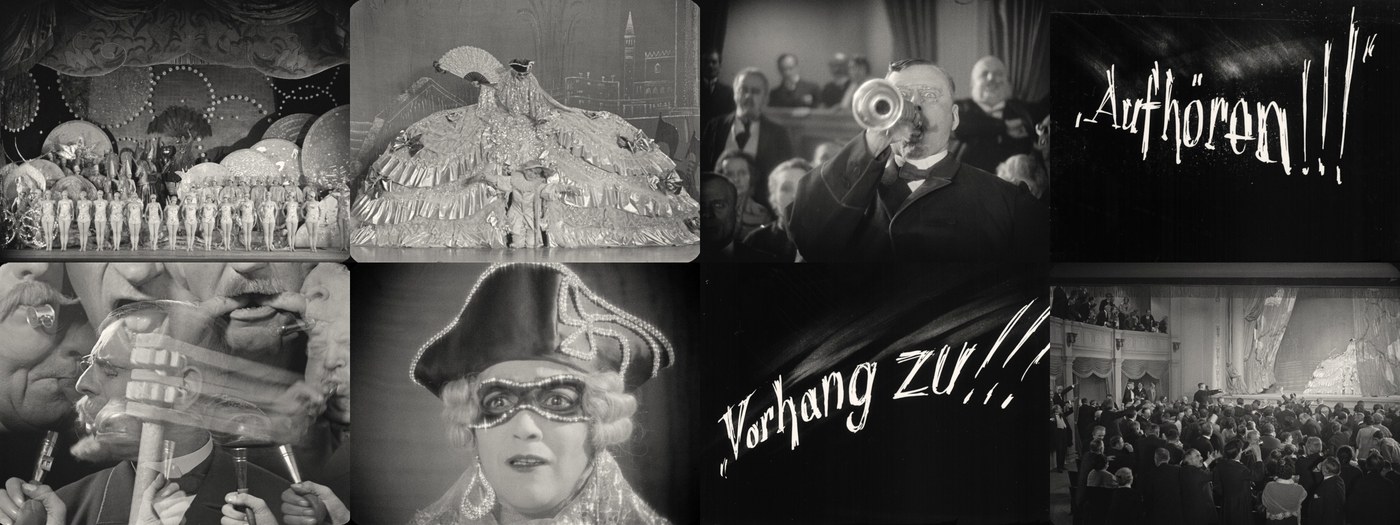
Horns, rattles, boos: The moral guardians drive Ninon (Ellen Richter) off the stage. Frame grabs from Moral (DFF) with intertitles designed by Karl Jaschob.
Out of the Shadows of Film History
For a long time, it seemed that the National Socialists had succeeded in erasing Ellen Richter’s name, along with those of many other Jewish filmmakers, from the memories of their fans—indeed, in removing them entirely from film history. In the years and decades after her career was forcibly brought to a premature end, references to Richter’s role in German cinema published in her lifetime were exceedingly sparse.3 She was not even deemed worthy of a footnote in Siegfried Kracauer’s and Lotte Eisner’s seminal works on Weimar cinema, From Caligari to Hitler (1947) and The Haunted Screen (1969, first published in French in 1952), which established the terms in which this period in film history would henceforth be conceived and discussed.4
Her involuntary retirement, her ostracism by the Nazis, and the indifference of scholars and journalists were not the only reasons Ellen Richter was so completely forgotten. Her métier was popular cinema: her aim was to entertain the broadest possible audience with solidly made films. Richter and Wolff did not aspire to advance the art or language of cinema or to formal innovation beyond choosing themes characteristic of their time. Often made with a high degree of craftsmanship, their films provided audiences with their proverbial “daily bread”, relying on proven formulas, conventions, and genres.
Audiences liked the films; otherwise, Ellen Richter could not have kept the production company she founded in 1920 afloat for so long in a highly competitive market. The critics less so. And it was often former critics who later played a major role in determining which films were to be considered important and worthy of remembrance and which were not. Ellen Richter neither appeared in stylistically outstanding works of German Expressionism or New Objectivity, nor did she act under auteur directors such as Fritz Lang, Friedrich Wilhelm Murnau, or Georg Wilhelm Pabst.
Unlike the films of these directors, Richter’s films never entered the canon of Weimar cinema. They lacked artistic prestige and therefore, in later years, had no advocates within the state and municipal film archives, cinematheques, and film museums charged with preserving Germany’s cinematic heritage. Consequently, for decades the preservation and accessibility of Ellen Richter’s films possessed no sense of urgency.
What we know today about some of the greatest female stars of German silent and early sound film, we owe first and foremost to the women themselves. The memoirs and autobiographical writings of Asta Nielsen, Henny Porten, and Pola Negri offer insights into their personal lives and professional careers, and what it meant to be a film star. Ellen Richter never wrote an autobiography; the memory of everything she had lost was too painful. Only shortly before her death did friends manage to persuade her to begin writing her memoirs, but she did not live to complete them. The manuscript does not survive.
Of the seventy-plus films Richter made, only just over a quarter survive, scattered across many locations. Most exist only as shortened and reedited foreign versions, damaged and fragmented, with heavy wear-and-tear or missing footage. It is thanks to DFF – Deutsches Filminstitut & Filmmuseum, the German Federal Archives (Bundesarchiv), Eye Filmmuseum, the Friedrich Wilhelm Murnau Foundation, Filmarchiv Austria, FPA France (formerly Lobster Films), and their international archival partners that eight films produced by and starring Ellen Richter have been digitized and restored since 2019: Leben um Leben (Life Upon Life, 1916), Der Aberglaube (Superstition, 1919), Lola Montez, die Tänzerin des Königs (Lola Montez, The King’s Dancer, 1922), Der Flug um den Erdball (The Flight Around the World, 2 parts, 1925), Moral (Morality, 1928), Die Abenteurerin von Tunis (The Adventuress from Tunis, 1931), and Strafsache van Geldern (The Van Geldern Case, 1932).
Combined with earlier, sporadic preservation efforts (for instance, Richter’s 1925 thriller Schatten der Weltstadt [Life’s Shadows] had been subject of a high-profile restoration by Murnau Foundation in 2006 and was presented at the Berlinale – Berlin International Film Festival in 2008), a coherent body of films once again became accessible, enabling for the first time major retrospectives at the Pordenone Silent Film Festival in 2021, at the Arsenal cinema in Berlin in 2022, and at the Metro Kinokulturhaus in Vienna in 2026.5

Dramatic, comedic: Ellen Richter in four films she made before Moral, all of which survive. Frame grabs from (left to right): Der Aberglaube (Eye Filmmusem); Das Bacchanal des Todes, with Werner Krauss (Eye Filmmuseum); Die Tochter des Mehemed, with Emil Jannings (Filmarchiv Austria); Lola Montez, die Tänzerin des Königs (DFF).
A Stroke of Good Fortune
Nowhere is the degree to which the preservation and study of Weimar film heritage depend on lucky accidents more clearly demonstrated than by the comedy Moral, which – thanks to recent retrospectives – has emerged as a key work by Richter and Wolff. In 1927, Richter and Wolff separated from Universum Film AG (Ufa), Germany’s leading studio which had commissioned and distributed all their films since they established their independent production company in 1920. Moral was their first production after leaving Ufa. Released by Matador, the German distribution arm of the American major studio Universal Pictures, the film revealed Ellen Richter and Willi Wolff as her director, to be in possession of strength and determination, dispelling any doubt about their creative energy.
The Berlin press greeted Moral extremely warmly after its premiere on January 20, 1928, calling it “a success such as few Ellen Richter films before it had achieved.”6 The updating of Ludwig Thoma’s play was said to be “witty, pointed, fresh, lively,” and the direction “brisk” and “fast-paced.”7 Here, Willi Wolff showed where his true talents lay: “This kind of raucous comedy, with uproar, broad jokes, and the atmosphere of a revue—that he can do.”8 Ellen Richter, perfectly matched to the material, was “once again in top form as a star—lively, graceful, sparkling with wit and spirit.”9 Thoma’s well-known comedy experienced a “resurrection” on film, wrote the Social Democratic newspaper Vorwärts: “In contrast to the many insipid German film comedies, here for once is a direct hit, achieved in genuinely cinematic fashion through visual effects and not merely through witty intertitles.”10
The stroke of good fortune is that the film’s camera negative—the most original film element offering the best possible image quality—survives at the German Federal Archives.11 In 1937, by means still unknown to us, the negative made its way into the collection of the recently founded Reichsfilmarchiv, at a time when Richter and Wolff were already in Austrian exile and the private and company property they had left behind in Germany had been confiscated by the National Socialist authorities. Unfortunately, the entire first reel and first half of the fourth reel are missing from the negative. The order of the shots is also mixed up in one key sequence in the second reel, and instead of proper intertitles the negative contains so-called “flash titles” measuring only one to three frames each, which at normal projection speed appear as brief flashes (hence the name) and are not legible to viewers. Because of the missing footage and lack of full-length intertitles, the camera negative is at just over 3,800 feet little over half as long as the 81-minute premiere version (approximately 7,270 feet).12
A second stroke of good fortune was the existence of a vintage Spanish release print of Moral that survived in the collections of the Filmoteca Valenciana under the title El diario de Ninón. It bears witness to the wide international circulation and reception of Ellen Richter’s films in her heyday. Most (alas, not all) of the footage missing from the camera negative was present in the Spanish print. Czech, Swedish, and Dutch censorship records supplied information about the film’s editing order and the wording of its intertitles. Drawing on these and other sources, a new version could be assembled from the digitized German and Spanish materials, which reconstructs the original length, titling, and editing as closely as possible. Some scenes are still missing from the 79-minute restored version. These have been substituted by title cards from the censorship documents and, in one case, a vintage publicity still, so the plot can be followed without difficulty. Digital post-production tools were used to remove signs of wear and tear and other damages, and to harmonize the visually divergent source elements, while remaining faithful to the “look” of a late-1920s commercial film production.
The majority of the original intertitles, hand-drawn by the Berlin-based graphic designer Karl Jaschob whose artistic and playful rendering of the text contributes substantially to the film’s comic effect, could be recovered from the flash titles. The missing intertitles were reconstructed in a less-elaborate adaptation of Jaschob’s style.13
The Morality Guardians Mobilize
Almost twenty years before her success in the film adaptation of Moral, Ellen Richter had appeared, in the early days of her acting career, in Ludwig Thoma’s play when it was staged in March 1909 at the Kleines Theater in Brno, where she received her first theatrical engagement after graduating from acting school in her home town Vienna. With its biting critique of bourgeois hypocrisy, submissiveness, and censorship, Thoma’s comedy was then enjoying a triumphant run throughout Germany and the German-speaking countries, ultimately becoming one of Thoma’s greatest popular successes.14 Nearly twenty years later, its success had not been forgotten, inspiring independent producers Richter and Wolff to adapt the play for the screen.
The play is set in a small duchy where the local Society for the Suppression of Vice ensures that violations of bourgeois decency and morals are rigorously prosecuted. Following an anonymous complaint, the police arrest a woman named Ninon de Hauteville, who runs a private salon where she receives prominent high-class gentlemen for assignations. The arrest places several members of the society in the gravest embarrassment, since they themselves had secretly been among Ninon de Hauteville’s clients. Ninon also kept a diary recording all her male visitors. The men now do everything they can to prevent their own immoral conduct from being exposed in a public trial. Ninon ultimately receives a large sum of money in return for maintaining discretion about her visitors and leaving town. The charges against her are dropped after it emerges that even members of the ducal court were among her clients.
Whereas Ninon de Hauteville appears only briefly in the play and is chiefly talked about, she takes center stage in the film adaptation. The “lady of leisure,” as the character is designated in the play, is transformed in the film into a 1920s revue performer, portrayed by Ellen Richter as a sophisticated woman of the world—radiant, charming, and admired by everyone.
The film opens with Ninon traveling alone by train from Berlin to Emilsburg, where she is to perform at the local theater. En route, an older gentleman (played by Jakob Tiedtke) makes amorous advances to the woman, who is dressed in the latest fashion in a fur coat and stylish hat. He introduces himself as “Herr Meier,” but his real name is Beermann and, according to his calling card, he is both a member of parliament and chairman of the Emilsburg Society for Public Morality. Ninon manages to evade his importunities by playing a trick on him, making him look ridiculous in the process.
At its meeting, the Emilsburg Society for Public Morality, a group of seemingly respectable gentlemen, works itself into a fury over alleged obscene and trashy literature. They plan a protest against the widely advertised Berlin revue “Tempo! Tempo!” featuring the scene “The Prince and the Lady-in-Waiting,” in which a prince crawls out from beneath the enormous dress of a court lady. The self-appointed moral guardians regard this as a mockery of the local Duke (played by Julius Falkenstein). Yet the Duke, in contrast to how the society members view him, has a penchant for women in show business and mildly risqué performances. Through private music lessons, he hopes to convert his overly stiff and timid son (played by Harry Halm) to the joys of life and open the door for him to revelry, dancing, and women.
At the theater, the revue plays to a full house, with long rows of dancers swinging their legs in front of magnificent stage sets. When “The Prince and the Lady-in-Waiting” is finally performed, with Ninon in a Rococo costume and masked face, the members of the morality society launch into a prearranged public demonstration: stomping, blowing horns, shaking rattles, and shouting their outrage at the “filth” on display. They drive the star from the stage, threaten the theater manager with a boycott, and demand that Ninon no longer be allowed to perform.
Ninon leaves the theater but remains in Emilsburg and, at the Duke’s request, becomes private piano teacher to his son. In her presence he quickly thaws, aided by Ninon’s exceedingly seductive dress, cut very low in the back. She also receives other private piano pupils at her villa: the various members of the morality society, all gentlemen of somewhat advanced age who preach morality in public but privately hope for an erotic adventure with the former showgirl. They all appear at Ninon’s under false names—various spellings of Meier, Meyer, Maier, etc. In an update of Thoma’s play, the diary is replaced by the latest in recording technology: cinema itself. Ninon has a hidden camera installed and secretly films her hypocritical male visitors. Even her fiercest opponent, the potbellied secondary-school professor Wasner (Ralph Arthur Roberts), pays her a visit. Ninon offers him a drink as a peace-offering, which leaves his trousers soaked, forcing him to take them off. To avoid an encounter with the duke’s son while in his underwear, must hide on the balcony in the freezing cold.
Later, Ninon is arrested and thrown in a filthy cell. Word quickly reaches the morality society that the police have confiscated secret film recordings of her illustrious visitors. Beermann and Wasner go to great lengths to obtain and destroy the footage before the police can view it. The judicial assessor (Albert Paulig), who wants to make an example of Ninon in the campaign against immorality, is called off by the police chief after the ducal court intervenes, and Ninon is released. At the end, she gathers the members of the morality society and forces them to apologize to her for the fiasco in the theater, and cheer the loudest at her forthcoming performance.
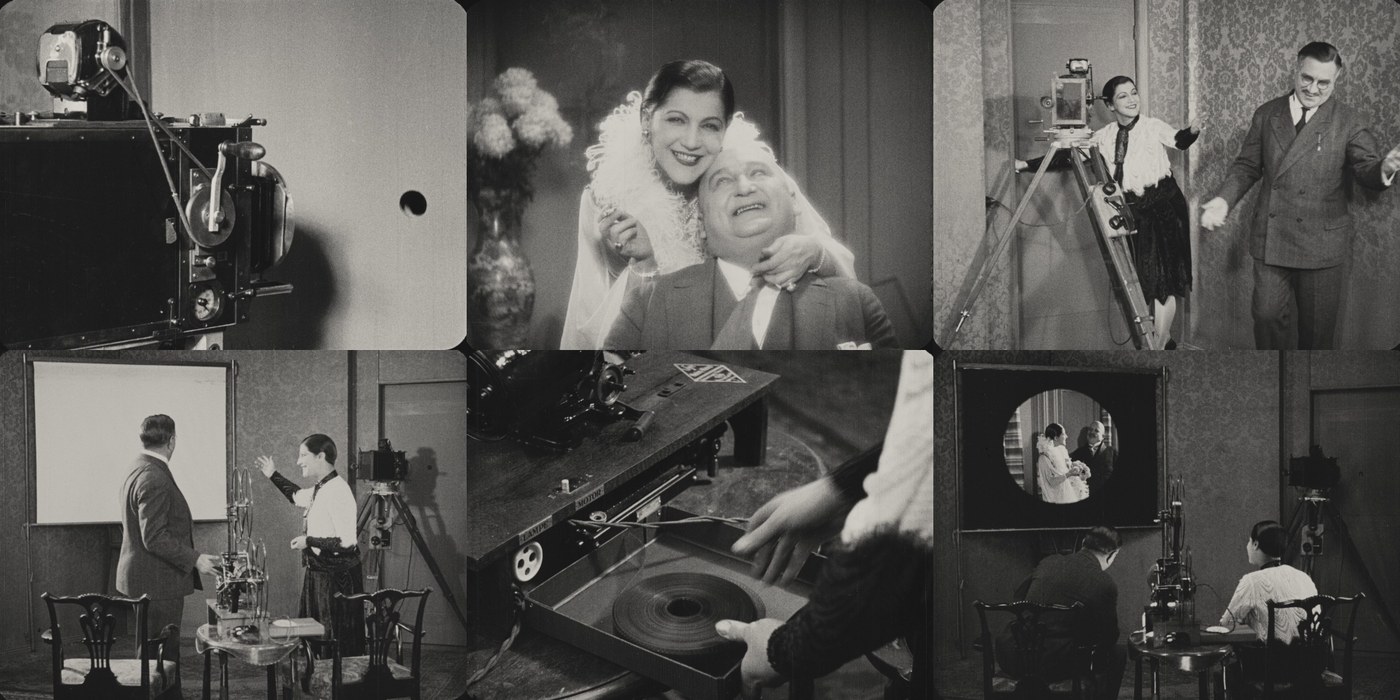
The hidden camera and the private screening: Ninon (Ellen Richter) presents her film “diary”. Frame grabs from Moral (DFF).
“Esperanto of Legs”
Moral tells the story of a conversion—or, one might say, of a successful therapy. Those who, as moral guardians, suppress the visual pleasure of others are themselves the chief victims of their actions and are permitted to admire the object of their desire only secretly, no longer in public. The film’s humane humor lies in the fact that, by the end, the guardians are allowed to rejoin the spectators and overcome their affected schizophrenia. Along the way, Ninon—the object of desire—turns the tables, placing the men before the camera lens and transforming them into the object of observation. This is an additional joke, and a particularly pointed one for proponents of theories of the male and female gaze.
The awakening and fulfillment of genuine visual pleasure constitute the greatest difference between the stage play and its film adaptation. The pleasure of polished dialogue gives way in the cinema to pure visual delight, reaching its first culmination in the theater scenes in the second reel. These scenes include genuine footage from Herman Haller’s 1927 revue Wann und wo? (When and Where?) featuring the Lawrence Tiller Girls and the dancers Marcella Rahna, June and John Roper, and Thelma de Lorez. These shots are Moral’s true showstoppers. If Ellen Richter provides the link to Ludwig Thoma’s play, Willi Wolff connects the film to Herman Haller, Berlin’s best-known and most successful revue impresario alongside James Klein and Erik Charell.15
As writer, producer, and—from 1922—sole director of Ellen Richter’s films, Wolff certainly had enough to do. Between 1920 and 1925, moreover, the film expeditions he undertook with his wife to Southern Europe, North Africa, and Asia kept him traveling for extended periods each year. Nevertheless, during the 1920s he renewed his pre-World War I collaboration with Haller. Beginning in 1923, Haller mounted a new large-scale revue every year at the Admiralspalast, which seated more than two thousand spectators. Each production ran for many months and attracted a largely international tourist audience numbering in the hundreds of thousands. The team remained unchanged for more than five years: Wolff wrote the lyrics with Rideamus (Fritz Oliven) and Haller; Walter Kollo composed the music; and Hermann Feiner directed. After the first revue, Drunter und drüber (Upside Down, 1923), Wolff also contributed to Noch und noch (Again and Again, 1924), Achtung! Welle 505 (Attention! Frequency 505, 1925), An und aus! (On and Off!, 1926), and, finally, Wann und wo? (When and Where?, 1927).
Haller’s revues were epic spectacles and the talk of the town. “The interplay of lavish décor and nude tête-à-tête determined the character of these orgies for the eyes,” wrote Heinz Greul.16 Hit songs from the revues were released on 78 rpm records. Haller featured the long-legged chorus line of the Tiller Girls and assembled leading figures of the Berlin cabaret and vaudeville scene, including Kurt Lilien, Max Ehrlich, Paul Morgan, Willy Schaeffers, and Trude Hesterberg. His revues were famous for their elaborate sets and costumes and notorious for their permissiveness: where else could one see so many unclothed, young, athletic female bodies in one place? Numerous nude photographs of the dancers appeared in the lavishly illustrated programs alongside texts by the writer Walter Hasenclever, the art historian Oscar Bie, the reporter (later filmmaker) Billie Wilder, and the society journalist and women’s tennis champion Paula von Reznicek.17
“The revue is above all a feast for the eyes,” the fashion critic Elsa Herzog wrote in 1926 about An und aus: “If today the language of legs is often more eloquent than song, and the brightly colored image is placed before the word, there are good reasons for this. The revue must be international in orientation; it must […] offer amusement and diversion to foreigners who do not speak the country’s language. The language of little legs is Esperanto; the beautiful stage picture is Volapük.”18
The bob-haired Tiller Girls’ “Esperanto of legs” was first “heard” on the cinema screen in in Ellen Richter’s 1927 comedy Die schönsten Beine von Berlin (Saucy Suzanne) and then again in Moral.
Who Still Wears Long Braids Nowadays?
Like several of Richter’s earlier films, Moral at times resembles a fashion show: even off-stage, the heroine’s ingeniously cut dresses are extraordinarily extravagant and varied, shimmering metallically at one point, covered in soft feathers at another. And just as the film’s connections to revue theater are unmistakable, so too is its connection to contemporary fashion culture.
“A well-made film must at all times look like an impeccable fashion magazine,” declared a 1918 handbook for aspiring film actresses.19 Ellen Richter, the daughter of a tailor and herself highly fashion-conscious, followed this maxim as both star and entrepreneur, appearing in her films and on countless star postcards in an ever-changing wardrobe. She was presumably also responsible for acquiring the clothes. Near her apartment on the Kurfürstendamm, she had many boutiques and shops from which to choose. Her films Wie einst im Mai (The Ways of Romance, 1926), Kopf hoch, Charly! (Bigamie, 1926), and Die Dame mit dem Tigerfell (The Woman in the Tiger Coat aka The Carnival Crime, 1927) are even set directly in the fashion world, revolve around the lives of models, and place unusual garments at the center of the narrative.
Aside from her films, Ellen Richter—whose links to the Berlin fashion industry reached back to her time as a stage actress at the Theater am Nollendorfplatz in 1913—also became something of a fashion icon off-screen.20 Photographs in the illustrated press contributed to this image, as did her crowd-pleasing appearances at the annual Press Ball, one of Berlin’s major social events. On these occasions, daily newspapers repeatedly focused on Richter’s striking formal attire, printed drawings of her dresses, and dropped the names of their designers. Between 1927 and 1929, for instance, she appeared in extravagant gowns by Johanna Marbach, a designer established in Berlin since 1915, including a “period dress with a novel Turkish skirt in yellow moiré and a rhinestone bow” and “a white satin-silk dress with a long side panel.”21
Mila Ganeva’s observations on Die Dame mit dem Tigerfell can easily be applied to Moral: “The film revels in outfits that are never plain or simple but extravagant and unique, made for a demanding audience with a desire for visual splendor. Above all, the actress’s dresses are enormously photogenic: they shine and glitter, display sharply contrasting patterns, and feature striking ornaments. This is the Ellen Richter look.”22
Changing hairstyles complete this look. The latest craze in the late 1920s was the bob, a short haircut for which many women sacrificed their long hair and braids.23 At a time when fashion-conscious women wore men’s shirts, trouser suits, and neckties, the androgynous hairstyle slightly blurred conventional gender boundaries. Here too, music and revue culture acted as a catalyst. In Walter Kollo’s hit record “Der Bubikopf,” taken from the 1924 operetta Die tanzende Prinzessin (The Dancing Princess), he sang the mildly ironic refrain: “Go on, get yourself a bob—who still wears long braids nowadays? The bob, ah, the bob, is so very modern now!”24
“The bob is loved and hated,” notes Anjeana Hans, summarizing the fierce debates over the new haircut and its implications for domesticated or emancipated femininity.25 With regard to Ellen Richter, she points out that the actress adopted the bob relatively late, in 1927/28, but that it strongly shaped her public image in the years that followed.
In Moral, the presentation of the bob is positively celebrated. After driving her from the stage with their staged demonstration, a delegation from the morality society visits a noticeably furious Ninon in her dressing room. She recognizes Beermann among the party as the man who had unsuccessfully made advances on her on the train to Emilsburg and even tried to kiss her. Coolly, she removes the powdered Rococo wig that belongs to her costume, revealing a glossy black short haircut. Only now does Beermann recognize her as the woman on the train who had rebuffed and humiliated him. “The apostle of morality has been seen through in his double standard. The revelation comes as a shock.”26
Later in the film, Ninon sits down for tea beside her new piano pupil, the duke’s shy son. Their hairstyles, down to the emphatic side part, are so similar that they almost look as though they have just visited the same barber. Ninon’s short black hair is styled so sleekly that the light reflects sharply from the crown; her ears are exposed and the nape is shaved. Without her earrings, one might assume that two young men are sitting together. Her feminine side becomes apparent only when she turns around and dramatically displays a dress whose back is cut almost to her buttocks.
A scene still missing in the restored version of Moral, but documented in other contemporary written and photographic sources, centers on Beermann’s daughter Effie (Hilde Jennings). Effie is the role Ellen Richter had played in the 1909 Brno stage production of Moral. She is secretly involved with the painter whose poster for the visiting Berlin revue “Tempo! Tempo!” arouses great curiosity in the provincial town. A surviving publicity still depicting the painter’s studio was incorporated into the reconstruction in place of the missing film scene. The photograph reveals Effie sporting a modern short haircut while holding a long, severed, braided pigtail in her hand. It suggests that the revolutionary—or at least dissident—force emanating from the women in this film also has a strong fashion-driven aesthetic dimension, like the heroine’s bob and trousers. “Effie holds the long, cut-off braid in her hand like a trophy. The old adage says it all: Der Zopf ist ab (the braid is gone), the old rules are passé, yesterday’s authorities have abdicated,” Hans concludes.27
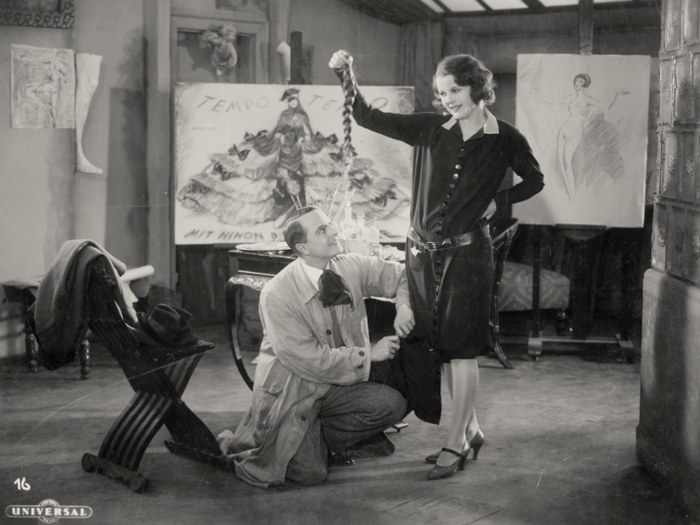
The braid is gone: A publicity still standing in for a missing scene in the restored version of Moral (DFF).
Lola Lola’s Older Sister
Moral represents the culmination of Richter and Wolff’s filmmaking. It perfectly combines all the traits that distinguish their films; traits which are less convincingly balanced in many of their other films: Ellen Richter’s (self-)presentation as an elegant lady and fashion icon; as a mischievous performer who particularly relishes in taking on men seeking to restrict her freedom of movement, her role-playing, and her insistence on emancipation; and as an ensemble player who gives her fellow on-screen performers, especially the comedic character actors, ample room to flourish. Almost exclusively throughout the entire film, Ellen Richter appears alongside male actors.
A small but unforgettable comedic role in Moral belongs to Ninon’s placid, plump housekeeper or maid. She opens the apartment door to the various fat, thin, short, or tall members of the morality society, receives each man’s bouquet, and places it on a chest of drawers that very quickly runs out of space for the growing number of flowers. The repeated introductions of the supposed piano pupils as Meier, Meyer, Maier, or Mayr are met first with a slightly raised eyebrow, then with suspicion, and finally with complete stoicism. It is a scene straight out of a slapstick film, repeated several times, each time with a slight variation: sheer delight. Yet despite her scene-stealing performance, the comedienne has been forgotten; her name does not even appear in the credits. A shame.
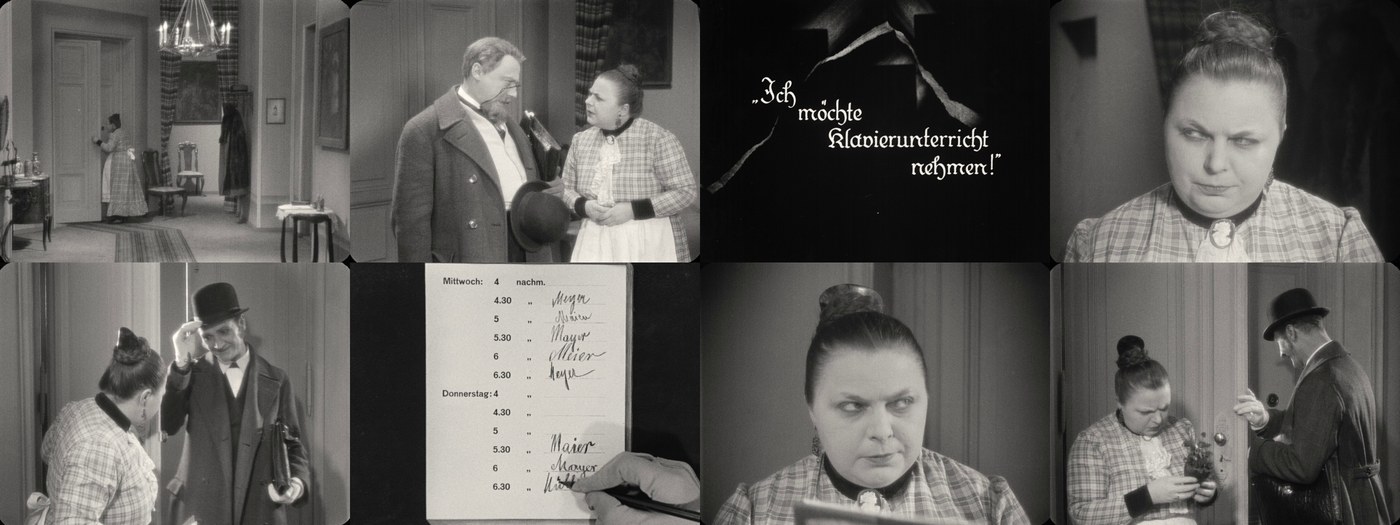
Who recognizes this comedian? Ninon’s housekeeper sees right through her prospective male piano pupils. Frame grabs from Moral (DFF).
The outstanding male character actor in Moral is Ralph Arthur Roberts. His portrayal of Professor Wasner is such that Emil Jannings’ Professor Rath in Der blaue Engel almost seems an imitation. This is partly due to the screenplay, co-written by Wolff together with seasoned scriptwriter Bobby E. Lüthge and, notably, Wolff’s regular writing partner Robert Liebmann, who in 1929 collaborated on the screenplay for Der blaue Engel. Professor Wasner’s entire characterization seems to prefigure Professor Rath: large and imposing, with a fetishized beard and a suit like armor, unmarried, petty, conceited, and thoroughly stuck in the past.
Aspects of Moral’s mise-en-scène also anticipate important ideas in Der blaue Engel. During the train journey, the stage figure Ninon de Hauteville is first introduced through a photograph in the magazine Uhu, just as Marlene Dietrich’s Lola Lola is initially presented through a poster before appearing in person. And like Rath, Wasner, too, becomes aware of Ninon’s scandalous number “The Prince and the Lady-in-Waiting” only through a prank by the boys in his secondary-school class. The pupils allow themselves to be distracted from his overly exaggerated lecture—on the monogamy of the ancient Germanic peoples, thereby exposing Wasner’s German-völkisch nationalist views—by an advertisement secretly passed along the rows before they are caught and Wasner confiscates the advertisement. It depicts Ninon in the enormous Rococo dress and a man crawling out from underneath said dress. One artistically gifted pupil turns the man under the dress into a caricature of Wasner. A not dissimilar scene occurs in Der blaue Engel, where the professor ultimately wants nothing different from his adolescent pupils: a peak under the skirt of the woman in the picture.
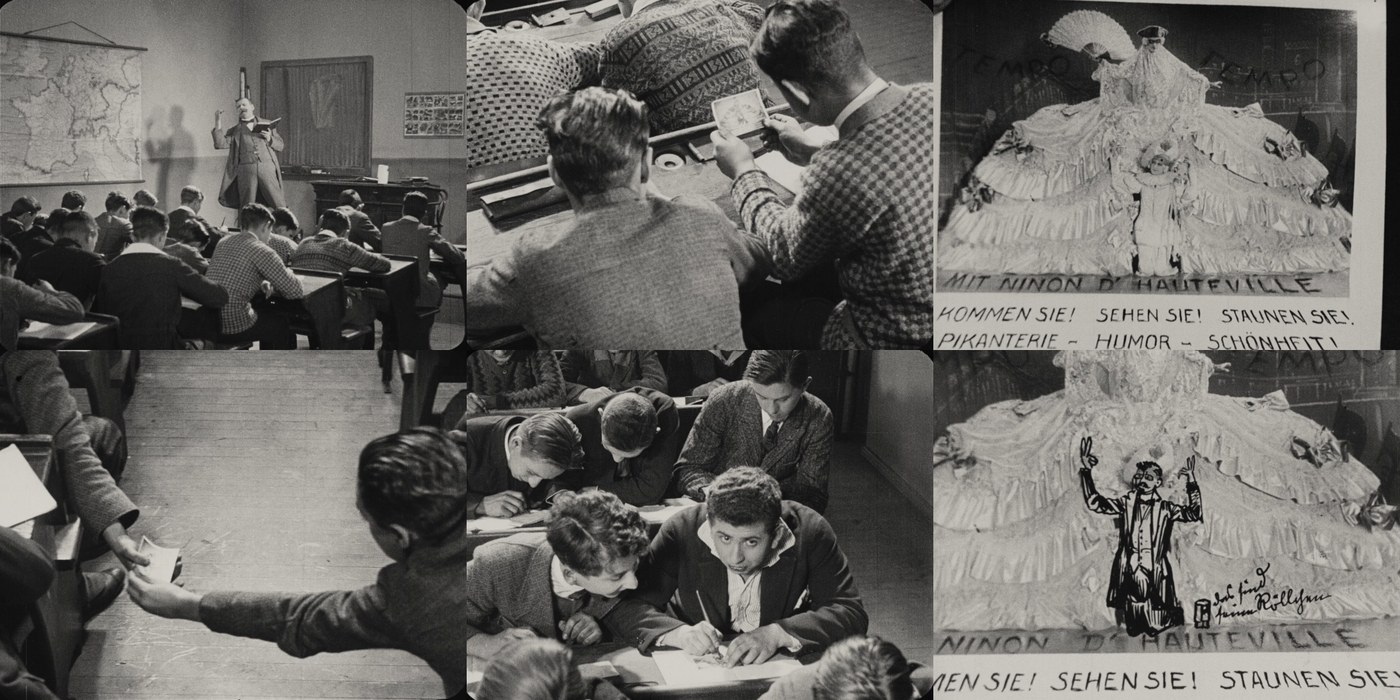
Before Marlene Dietrich, there was Ellen Richter: In the classroom, a naughty picture of the dancer Ninon is passed from hand to hand. Frame grabs from Moral (DFF).
The manner in which the supposedly despised stage performer gradually wins over the teacher—the aging embodiment of bourgeois respectability—, butters him up with compliments, and rekindles his extinguished libido is presented by Ellen Richter and subsequently by Marlene Dietrich in strikingly similar and self-assured fashion. Dietrich had played her first leading role in the 1927 Ellen Richter production Der Juxbaron (The Imaginary Baron).28 This fact makes experiencing Moral’s resurrection after nearly a century of invisibility, and the rediscovery of Ninon as Lola Lola’s cinematic older sister, all the more pleasurable. (It should be noted in passing that the recently restored Ellen Richter films also include the star’s personal favorite, Lola Montez, die Tänzerin des Königs, from 1922, in which Richter likewise plays a much-admired stage performer who exercises power over men—and appears, not merely because of her name, to be a precursor of Lola Lola.)
Staying Alive
Before the two representatives of the morality society visit Ninon after the theater scandal, they announce their intention in an intertitle: “Und nun werden wir einmal mit der Person deutsch reden!” (And now we are going to speak German to that person!) In other words, what had previously taken place on the stage represented, for these self-appointed apostles of morality, was the exact opposite of proper German culture. Almost in passing, Moral reminds us how endangered the entertainment culture to which the film itself belonged—and to which it bears witness—already was. That culture was repeatedly attacked as “non-culture” and “un-German,” codes that implicitly, and shortly afterward quite explicitly, defamed it as “Jewish.” 29 Beginning in 1933, the accusation “Jewish” was itself sufficient grounds for professional prohibition and state persecution.
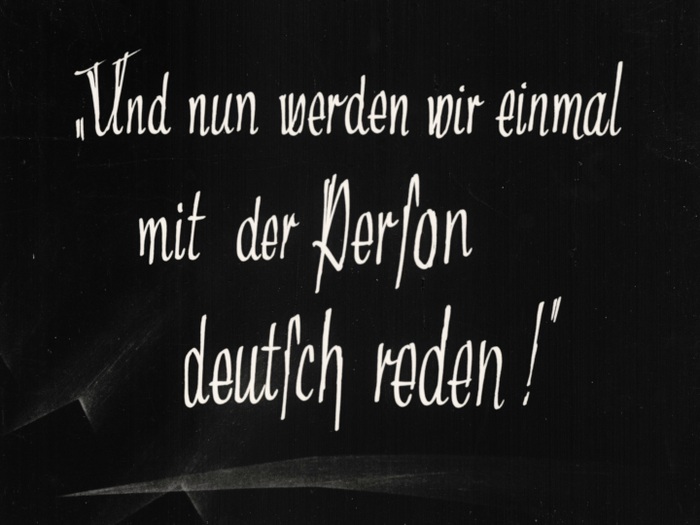
“And now we are going to speak German to that person!” Title design by Karl Jaschob. Frame grab from Moral (DFF).
In many respects, Moral functions as an archive: an archive of gender relations, social frictions, oppositions within Germany, clothing, and hairstyles. Moral is also the archive of a film culture that, alongside familiar classics dealing mostly with serious subjects, encompassed superbly crafted star vehicles and genre films—comedies, thrillers, action-adventure films—that entertained cinema-going audiences without patronizing them. Yet the term “archive” is used here in more than just a metaphorical sense. Moral also contains the only surviving quasi-documentary film footage from Haller’s revue Wann und wo? and benefits from its enormous visual attractions, including performances by the Tiller Girls. The film thus rather unintentionally rescues — and allows us to rediscover — a popular metropolitan entertainment art that serves as a symbol for both the liberalism and the vulnerability of Weimar culture. Ellen Richter and Willi Wolff themselves made outstanding contributions to this short-lived entertainment culture.
Anyone who doubts the self-reflexive dimension of Ellen Richter and Willi Wolff’s films should watch their recently restored “talkie” thriller Strafsache van Geldern (1932).30 In it, Ellen Richter plays Martha van Geldern, the owner of an exclusive Berlin fashion salon who becomes the victim of a murder in the course of the film. Martha is elegance personified, displaying muscular upper arms and a bob cut even slightly shorter than the one in Moral. Her exterior mirrors her interior: a powerful woman, determined and unsentimental.
Martha is introduced as a former stage diva who had been a major revue star and performed as La Bella Dolores, a glamorous entertainer in the most famous variety theaters. Here Strafsache van Geldern enters into a kind of inter-film discourse, alluding to the earlier, now lost revue film Die schönsten Beine von Berlin (1927). In this earlier film, Ellen Richter had played a supposedly Spanish (in reality Hungarian) dancer named La Bella Dolores. The film clearly made fun of national stereotypes and was itself accused by Zionist critics of disseminating antisemitic stereotypes.
The boundaries blur between Martha, the film character who was formerly La Bella Dolores, and Ellen Richter, the actress who plays Martha and who had herself once played La Bella Dolores. Two emancipated modern women, both with a past on the stage, both at home in the spotlight and in the world of fashion, two experts in looking beautiful: Martha and Ellen, Ellen and Martha—twin sisters. Who is who?
In a key dramatic scene in Strafsache van Geldern, Martha quarrels with her husband Paulus in the living room of her Bauhaus villa. Paulus is played by Paul Richter, a casting choice that could justifiably be dubbed ironic. We then see Minna (Lucie Höflich), Martha’s housekeeper, sitting in the garden beneath a parasol. She is taking a break and leafing through an illustrated magazine. A few pages after photographs of Marlene Dietrich as Lola Lola in Der blaue Engel comes a picture of La Bella Dolores in the revue “Nächte der Weltstadt”—a rather obvious reference to Richter’s 1925 silent thriller Schatten der Weltstadt. A shot of the clock on the tower of the Kreuzkirche in Berlin-Schmargendorf, an icon of Expressionist architecture, reveals that it is noon. Minna yawns and dozes off; a gust of wind turns the magazine’s pages; the still photograph of La Bella Dolores dissolves into moving images. We enter Minna’s dream and experience her memories, as she witnesses her employer and friend Martha resurrected in her most famous performances. The elaborate montage sequence incorporates scenes from Die schönsten Beine von Berlin; shots from the Haller revue with long rows of long-legged dancers; Richter in Ninon’s Rococo costume in Moral as well as other images from that film.31 Magnificent décor, exhilarating movement, radiant luxury, overflowing sensuality.
A scream. Minna awakens. Martha is dead. Ellen Richter has made her exit.
While Ellen Richter plays only a supporting role in Strafsache van Geldern, it represents the summation of an artistic career that lives on in the memory of her fans and repeatedly rises again each time the film is screened. Willi Wolff pays tribute to his wife Ellen Richter, the most important star of his films, while also recycling earlier footage. The result is a distinctive kind of film within a film, a found-footage film, an archive: a place where images are preserved; images that survived only by an indirect route in this film.
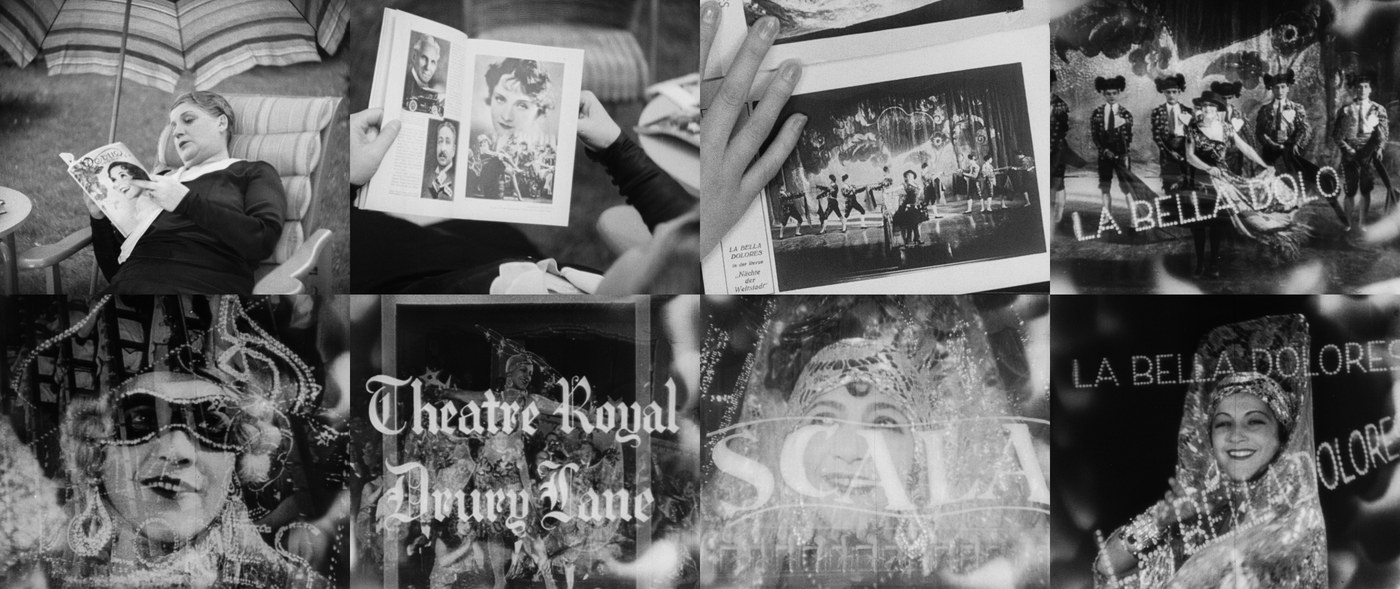
Film as a memory and a dream of what once was: Minna (Lucie Höflich) falls asleep, and the pictures from her magazine come to life. Frame grabs from the restored version of Strafsache van Geldern (Bundesarchiv) featuring images from Moral and the lost Ellen Richter films Die schönsten Beine von Berlin and Unmoral.
Footnotes
1 At the time of publishing, the restored version of Moral is not yet available to purchase on DVD/Blu-ray nor is it accessible for streaming via an officially sanctioned platform. Readers interested in viewing the film are advised to contact DFF’s distribution department at filmverleih@dff.film.
2 This article is mainly based on our book Ellen Richter. Die große Unbekannte des Weimarer Kinos (Vienna: Synema, 2026) which describes the biography and work of Ellen Richter and Willi Wolff. Regarding their film work in the context of Jewishness see Stiasny and Hanley, “‘Was wissen Sie von mir und meinem Werk?!’ Ellen Richter und das jüdische Filmschaffen in der Weimarer Republik.” In: Anna-Dorothea Ludewig, Ulrike Schneider, Lea Wohl von Haselberg (eds.), Jüdisches Filmerbe (Berlin: Neofelis Verlag, 2026). Notably, Ellen Richter briefly appears in disguise as an orthodox Jewish boy in Fürstin Woronzoff (1920) which is available to watch in the German Federal Archive’s Digital Reading Room: https://digitaler-lesesaal.bundesarchiv.de/video/1000/712642 (accessed August 10, 2026).
3 See the meager references in Oskar Kalbus, Vom Werden deutscher Filmkunst. Der Stummfilm (Altona-Bahrenfeld: Cigaretten-Bilderdienst, 1935), p. 49; Heinrich Fraenkel, Unsterblicher Film. Die große Chronik (Munich: Kindler Verlag, 1956), p. 144; Curt Riess, Das gab’s nur einmal. Die große Zeit des deutschen Films (Frankfurt am Main, West-Berlin, and Vienna: Ullstein Verlag, 1985; first published Hamburg, 1956), vol. 1, p. 131, and vol. 2, p. 129; Friedrich von Zglinicki, Der Weg des Films. Textband (Hildesheim and New York: Georg Olms, 1979; first published West Berlin, 1956), pp. 365 and 401.
4 See Siegfried Kracauer, From Caligari to Hitler: A Psychological History of the German Film (Princeton, NJ: Princeton University Press, 1947), and Lotte H. Eisner, L’Écran démoniaque (Paris: Éditions André Bonne, 1952).
5 See our program notes to the Ellen Richter retrospective in Pordenone including information on newly restored films in Catherine A. Surowiec, Piera Palat (eds.): 40th Pordenone Silent Film Festival. Catalogue (Pordenone: Le Giornate del Cinema Muto, 2021), pp. 55-93, available online at https://www.giornatedelcinemamuto.it/wp-content/uploads/2022/08/CATALOGO-GCM2021-WEB-v01.pdf (accessed August 10, 2026). For details of the Berlin retrospective “Ellen Richter – Weimar Cinema’s Action Queen” see https://www.arsenal-berlin.de/en/cinema/film-series/ellen-richter-die-grosse-unbekannte-weimar-cinemas-action-queen/ and https://www.arsenal-berlin.de/en/cinema/film-series/ellen-richter-die-grosse-unbekannte-weimar-cinemas-action-queen-2/ (accessed August 10, 2026). For details of the Vienna retrospective which included the premiere screening of a newly restored fragment of Die Tochter des Mehemed (1919) see https://www.filmarchiv.at/de/kino/filmreihe/sg_032Cy31qvPGIBs8lkzdzQf (accessed August 10, 2026).
6 “Moral,” Der Montag (Monday edition of the Berliner Lokal-Anzeiger), no. 3, January 23, 1928.
7 -ck. (Konrad Glück), “Moral,” Berliner Morgenpost, no. 19, January 22, 1928. The complete review is available (in German) at https://www.arsenal-berlin.de/assets/Kino/PDFs/Ellen_Richter_im_Arsenal_14.10.2022_Moral_Informationspapier.pdf (accessed August 10, 2026).
8 Georg Herzberg, “Moral,” Film-Kurier, no. 19, January 21, 1928.
9 Pf., “Moral,” Tägliche Rundschau (Berlin), no. 37, January 22, 1928.
10 D., “Moral,” Vorwärts (Berlin), no. 37, January 22, 1928.
11 On the restoration of Moral, supervised by Oliver Hanley, see the information in the opening credits of the restored version: https://www.filmportal.de/node/16903/video/1683076 (accessed August 10, 2026).
12 A preview video of the unrestored raw scan of Moral’s original camera negative is available in the German Federal Archive’s Digital Reading Room: https://digitaler-lesesaal.bundesarchiv.de/video/1813/658090 (accessed August 10, 2026).
13 The graphic reconstruction of the missing titles was carried out by then Bachelor student Karolina Sus in cooperation with the Conservation and Restoration degree program at HTW Berlin – University of Applied Sciences.
14 See Ludwig Thoma, Moral. Komödie in 3 Akten (Munich and Zurich: Piper Verlag, 1983; first published 1909), especially Bernhard Gajek’s afterword on the play’s origins and reception, pp. 83–99.
15 On Haller’s revues, see Wolfgang Jansen, Glanzrevuen der zwanziger Jahre (Berlin: Edition Hentrich, 1987), pp. 78–127.
16 Heinz Greul, Bretter, die die Zeit bedeuten. Die Kulturgeschichte des Kabaretts (Cologne and West-Berlin: Kiepenheuer & Witsch, 1967), p. 247.
17 In one of the programs, Paula von Reznicek points out the hypocrisy of philistine criticism directed at the appearance of scantily clad dancers. The philistine’s wife and daughter, who themselves practice gymnastics, are already more advanced: “They understand that nudity can attain perfection and feel that the union of beauty and grace can become an aesthetic pleasure that inspires and delights us without debasing us.” Paula von Reznicek, “Revue und Erotik,” in the program of the Theater im Admiralspalast for Haller’s revue Wann und wo? (Berlin, 1927), p. 32.
18 Elsa Herzog, “Revue und Kostüm,” in the program of the Theater im Admiralspalast for Haller’s revue An und aus (Berlin, 1926), p. 12. The programs for Haller’s revues can be viewed at https://www.notenmuseum.de/revue-programme/ (accessed August 10, 2026).
19 Max Otten, Der Weg zum Film, vol. 1, Der Filmschauspieler (Berlin: Verlag der Lichtbild-Bühne, 1918), p. 97. The booklet also contains a photograph of Ellen Richter admiring herself in a mirror. On the relationship between film and fashion, see Mila Ganeva, Women in Weimar Fashion: Discourses and Displays in German Culture, 1918–1933 (Rochester, NY: Camden House, 2008).
20 Most likely in the late 1910s, Ellen Richter appeared, together with several other female actors, in a filmed fashion show in a Messter-Woche newsreel, a fragment of which has survived at Eye Filmmuseum. The fragment is available on the Eye Filmmuseum’s YouTube channel: https://www.youtube.com/watch?v=VXjaRhtl7cw (accessed August 10, 2026).
21 Elsa Herzog, “Presseball,” Berliner Lokal-Anzeiger, no. 49, January 29, 1928; and Johanna Thal, “Presseball” (with drawings by Julia Haase-Werkethin), B.Z. am Mittag (Berlin), no. 25, January 26, 1929.
22 Mila Ganeva, “Ellen Richter und die Mode,” in Stiasny and Hanley, Ellen Richter, pp. 185–90, here p. 190.
23 For an excellent cultural history of the bob-haircut revolution in 1920s Germany, see Helga Lüdtke, Der Bubikopf. Männlicher Blick – weiblicher Eigen-Sinn (Göttingen: Wallstein Verlag, 2021).
24 For Haller’s 1925 revue Achtung! Welle 505!, Willi Wolff also collaborated on a bob-themed song entitled “Frauenhaar.”
25 Anjeana K. Hans, “Der Zopf ist ab. Ellen Richters Frisuren,” in Stiasny and Hanley, Ellen Richter, pp. 210–11, here p. 211. The following discussion of Richter’s hairstyle in Moral is based largely on Hans’s essay.
26 Ibid., p. 210.
27 Ibid., p. 211.
28 In one of the very few scholarly articles on Ellen Richter published thus far, Anjeana K. Hans analyzed Der Juxbaron. See “Das Kleine und Halbe. Die Ellen Richter-Film, die Ufa und Willi Wolffs Operettenadaption Der Juxbaron (1927).” In: Filmblatt, Vol. 25 (2020), No. 73/74, pp. 34– 49. DOI: https://doi.org/10.25969/mediarep/21471 (accessed August 10, 2026).
29 See Florian Odenwald, Der nazistische Kampf gegen das ‘Undeutsche’ in Theater und Film 1920-1945 (Munich: Herbert Utz Verlag, 2006).
30 The restored version of Strafsache van Geldern is available in the German Federal Archive’s Digital Reading Room: https://digitaler-lesesaal.bundesarchiv.de/video/2305/681896 (accessed August 10, 2026). Several historical reviews (in German) are available at: https://www.arsenal-berlin.de/assets/Kino/PDFs/Ellen_Richter_im_Arsenal_26.10.2022_Strafsache_van_Geldern_Informationspapier.pdf (accessed August 10, 2026).
31 The sequence also includes a photograph from Richter’s lost film Unmoral (1928).
About the Authors
Philipp Stiasny is a film historian based in Berlin. He is a member of the German film historians’ association CineGraph Babelsberg and one of the editors of its bi-annual journal Filmblatt. The many film series and retrospectives he has curated over the years include Weimar international (Berlin 2018/19, with Frederik Lang), of Kyjiw, Berlin, Hollywood. The Many Faces of Anna Sten (Berlin 2025), and Female Film Pioneers. Women Directors in Germany 1917-1932 (Berlin 2025, with Kristina Jaspers and Gerlinde Waz). His publications include the monographs Das Kino und der Krieg: Deutschland 1914–1929 (Munich 2009) and Ellen Richter. Die große Unbekannte des Weimarer Kinos (Vienna 2026), the edited volume Ufa international: Ein deutscher Filmkonzern mit globalen Ambitionen (Munich 2021), as well as numerous articles on German film history.
Oliver Hanley is a film preservationist based in Potsdam-Babelsberg. Following stints at the Deutsche Kinemathek (2008-2011), Austrian Film Museum (2011-2016) and the Film University Babelsberg KONRAD WOLF (2016-2021), he mainly works as a freelance film curator and editor. For DFF – Deutsches Filminstitut & Filminstitut, he supervised the restorations of the Ellen Richter films Leben um Leben (1916) and Moral (1928), as well as the Anna May Wong vehicle Großstadtschmetterling / Pavement Butterfly (1929), among several others. Together with Eva Hielscher, he is co-artistic director of the Bonn International Silent Film Festival (since 2021). He also curates the “A Hundred Years Ago” strand of Bologna’s Il Cinema Ritrovato film festival (since 2023) and edits FIAF’s Journal of Film Preservation (since 2024).